
How to Improve Employee Engagement With Walking Challenges: A Practical Guide for HR Teams
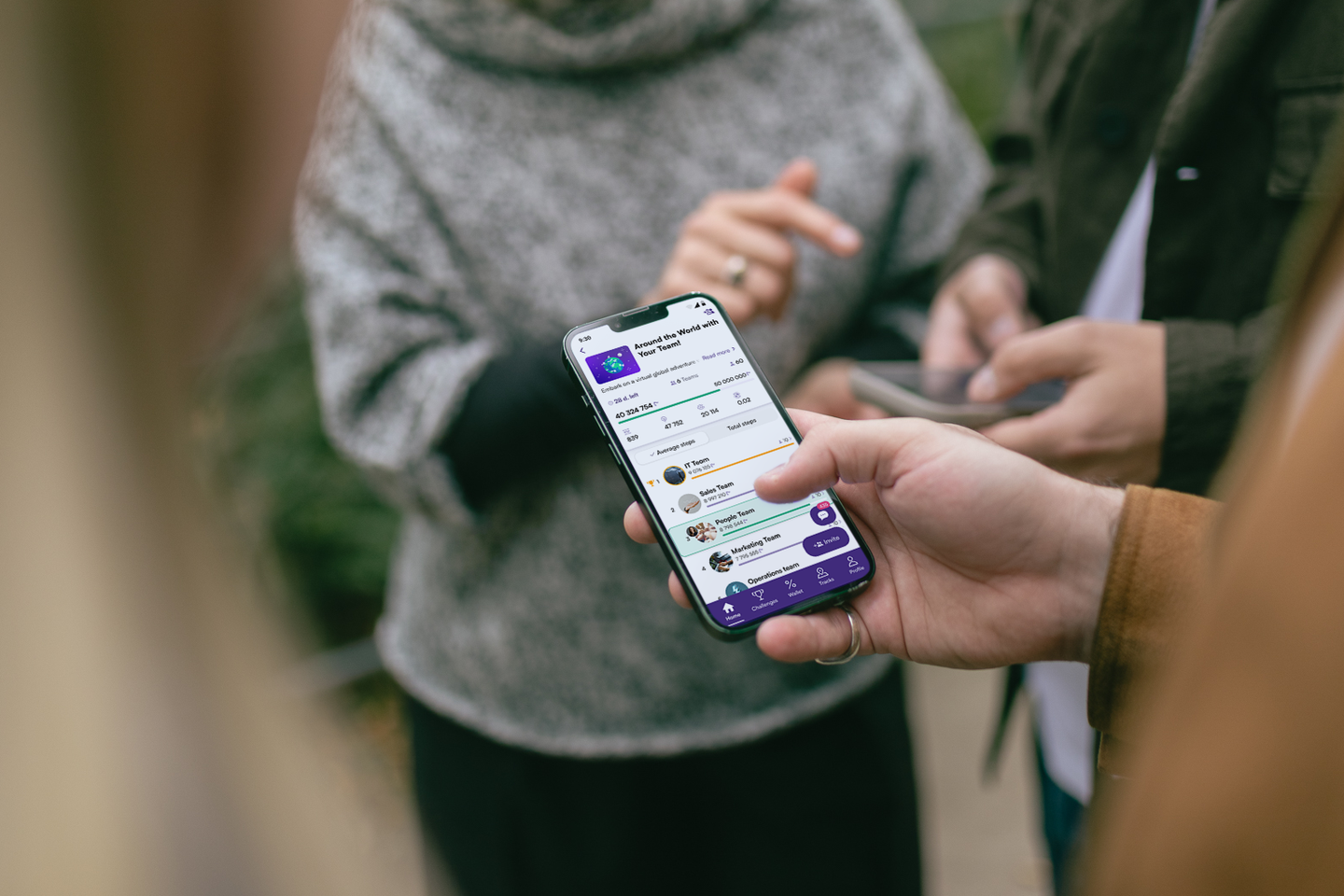
A workplace walking challenge gives HR teams a low-cost way to encourage movement, strengthen social connection, and create a shared goal. This guide explains how to design, launch, and measure a challenge that keeps people involved beyond the first week and produces results you can report to leadership.
The guide is intended for HR, People, and wellness leads planning a walking challenge for office-based, hybrid, or remote teams. The wider engagement context matters. Gallup's State of the Global Workplace: 2026 report found that global employee engagement fell to 20% in 2025, its lowest level since 2020. On its own, a walking challenge will not solve disengagement. A well-designed program can still be a practical, low-cost lever.
Key Takeaways
- A walking challenge can improve participation and mood, but it does not directly measure employee engagement. Decide before launch which result you intend to report to leadership.
- Build the challenge around one shared destination-style goal for the team or the whole company, such as covering the distance to Everest Base Camp or around the Earth. Everyone contributes to the same total.
- Steps are the right unit precisely because they are simple. One number, one scale, no interpretation required, and no one needs to learn a scoring system to take part.
- Two to four weeks is a practical range for a first challenge. This range is long enough to encourage a behavior shift but short enough to maintain interest.
- Reward at two levels: recognize the highest step totals, and run random draws among everyone who passed a participation threshold, so people who are not competitive walkers still have a real chance to win.
- Cost is the strongest argument to leadership. A walking challenge typically costs a fraction of a single team social event and includes every employee rather than only those who show up.
What do you need before starting a workplace walking challenge?
A workplace walking challenge is a structured, time-limited program in which employees track walking toward a shared team or company goal. An employer's HR or wellness function usually organizes the program.
Start by assigning one person to own the program. Ideally, that coordinator should have one or two wellness champions in other departments who can help communicate it. Confirm that every employee has access to a suitable tracking method, whether that is a wellness platform, a shared spreadsheet, or the step counter built into most modern smartphones.
Set a rough budget, if possible, because the available format changes when prizes or paid tools are involved. Agree on the shared goal and one success metric before launch so the wrap-up report writes itself.
On cost, a walking challenge is one of the cheapest employee engagement tools available. Setting one up for an entire workforce generally costs less than taking the same team out for a single evening, and it reaches everyone equally instead of only the people who can attend an after-work event. Per employee the figure often lands around the price of a few cups of coffee. Framed that way, it belongs in the budget as an investment in employee wellbeing rather than as an expense to justify.
A large platform contract or company-issued wearables are not required for a first challenge. The 2020 Cochrane review of workplace pedometer programs by Freak-Poli and colleagues described these interventions as low-cost compared with other physical-activity programs. That affordability helps explain why they remain common in workplace wellness budgets.
How to run a workplace walking challenge step by step
Run the challenge in the following order. Each step includes a decision to make and a common problem to avoid.
Step 1: Set one shared goal for the group
Give the team or the company a single collective target and express it as a distance or a destination rather than a number of steps per person. Walking to Everest Base Camp, covering the length of a famous trail, or circling the Earth as a company all work because everyone can picture the finish line.
Why it matters: a collective goal removes the awkwardness of comparing a field engineer who records 12,000 steps before lunch with a colleague in back-to-back calls. Both contributions move the same marker forward. It also changes the internal conversation from "how am I doing" to "how far have we got", which is the point of running the program in the first place.
Step 2: Organize the challenge around teams
Group employees into teams and show each team's combined progress toward the shared goal. Workplace wellness programs often use teams of three to eight people, with four or five commonly treated as a manageable size.
Why it matters: teams give people a reason to talk to each other during the challenge, and they spread the load so that a quiet week for one person does not stall the group. Smaller teams also reduce social loafing, where members assume someone else will carry the total. Individual results can remain visible alongside team progress, which helps participants see how their contribution fits into the wider challenge. A reporting dashboard can also give HR a clear view of both overall challenge performance and individual achievements, making it easier to recognize participants during and after the program.
Step 3: Keep the format to walking
Resist the temptation to build a complicated scoring system that converts every possible activity into a common currency. Walking is the format precisely because it needs no explanation.
Why it matters: almost anyone can walk. It requires no equipment, no gym membership, no booking, no change of clothes, and no particular fitness level. An employee can take part on the way to a meeting, during a phone call, or on the walk home. That is a far lower barrier than any activity that requires preparation, and it is why walking challenges pull in the colleagues who ignore every other wellness initiative. A single shared activity also keeps the group experience intact. Everyone is doing the same thing, in the same units, toward the same goal.
Step 4: Set the duration to two to four weeks
Choose a fixed start and end date that are two to four weeks apart for the first challenge. Participants should know the finish line from the beginning.
Why it matters: shorter challenges can create quick enthusiasm, while longer programs allow more time for habits to form but increase the risk of participants losing interest. Scotland's national Workplace Step Count Challenge runs for eight weeks and still recorded week-on-week growth in steps. Longer formats can work, but they require regular communication to maintain momentum. A shorter first run is easier to manage and evaluate.
Step 5: Plan three communication moments
Prepare three messages before launch. Send one at the start to explain the format, name the shared goal, and confirm that participation is voluntary. Send a mid-challenge update showing how far the group has travelled and which teams are moving fastest. Finish with a wrap-up that names the winning teams, the top individual walkers, and the prize draw results.
Why it matters: a walking challenge cannot be launched and then ignored. Wellness practitioners consistently identify visible communication from leaders, rather than leadership approval alone, as an important factor in maintaining participation beyond the first week. Silence after launch is one of the easiest ways for the challenge to fade. Progress updates against a shared destination give you something to say that is not just a leaderboard.
Step 6: Build a two-tier reward structure
Award a prize to the top participant or participants by total steps, and then run several prizes as random draws from the pool of everyone who passed a participation threshold during the challenge, for example 100,000 steps. Announce both tiers at the start.
Why it matters: a single prize for the highest step count turns the program into a contest that the same few people win every year, and everyone else works out within days that they cannot win. The random draw fixes this without taking anything away from the strongest walkers. Participants who are unlikely to finish near the top still have a genuine reason to keep going, because crossing the threshold is achievable and the draw is decided by chance rather than by fitness.
Two additions are worth building on top of that structure. First, it can help to choose a technical solution that lets participants exchange accumulated steps for small rewards. Even modest rewards can give each person an individual reason to keep moving alongside the collective goal. Second, a digital diploma issued to every participant at the end works well as recognition. It costs nothing, it acknowledges the people who took part without finishing near the top, and it is the kind of small artifact employees actually keep.
Why do walking challenges work for engagement, and where do they stop?
Walking challenges can support engagement because they combine a low barrier to entry with clear structure and a social reason to participate. The health case is well established. The World Health Organization's Guidelines on Physical Activity and Sedentary Behaviour recommend that adults complete 150 to 300 minutes of moderate physical activity each week, and walking is one of the most accessible ways for many people to reach that range.
For HR teams, the softer benefits are often just as relevant. A department-versus-department challenge can give colleagues who rarely interact a reason to talk. That cross-team contact may be valuable even though a step total cannot measure the depth of the connection.
Workplace-specific evidence also supports the activity and wellbeing benefits. A 2021 study in the International Journal of Environmental Research and Public Health by Niven and colleagues analyzed four years of Scotland's national Workplace Step Count Challenge across 10,183 participants. It found an average increase of 906 steps per day between week one and week eight. A 2022 follow-up on the same program by Ryde and colleagues reported positive self-reported changes in stress and productivity during the challenge.
The limits of this evidence are important. These studies measured steps, stress, and productivity. They did not measure an employee engagement score. A walking challenge can influence participation, mood, and cross-team contact, but it cannot repair disengagement caused by poor management or low trust.
Gallup's 2026 report identifies managers as a major pressure point and reports that manager engagement fell from 27% in 2024 to 22% in 2025. Where management quality or trust is the central problem, a walking challenge is a supporting initiative rather than the solution. Treating it as one part of a wider engagement strategy makes the initiative more credible.
How do you measure whether the challenge actually improved engagement?
To measure the value of a walking challenge, separate participation, collective progress, and engagement-related outcomes. Each metric answers a different question, so decide in advance which result matters most.
Participation is the easiest measure and still has value. Wellhub's Return on Wellbeing 2026 report found that participation rate was the most-used wellness success metric, cited by 53% of HR leaders. However, participation only shows that employees joined. It does not show that they became more engaged.
Progress against the shared goal is the metric most people will care about during the challenge itself. It is easy to communicate, it does not single anyone out, and it produces a clean headline for the wrap-up: the company covered a given distance together in a given number of weeks.
If you want to say something about engagement rather than activity, add a short optional survey question at the wrap-up asking whether the challenge created contact with colleagues people do not normally work with. Treat it as a soft signal, not as proof, and keep any survey responses separate from step records.
The following table shows what each metric can and cannot tell you.
Metric | What it tells you | What it does not tell you | How to capture it |
Participation rate | Percentage of invited employees who joined the challenge | Whether participants felt more engaged | Divide total sign-ups by invited headcount using data from the tracking tool |
Collective progress toward the shared goal | How far the group travelled together and whether the target was reached | How evenly the effort was distributed | Read the total from the challenge dashboard at the end of the program |
Threshold completion | How many participants passed the participation threshold used for the prize draw | Whether people walked consistently across the whole period | Count participants above the threshold at the end of the challenge |
Cross-team interaction | Whether participants formed new workplace connections | How deep or lasting those connections were | Add one optional wrap-up question about contact with new colleagues |
Interpret any survey movement cautiously. A two- to four-week period overlaps with other changes at work, so a shift is a signal rather than proof of causation. Careful wording makes the result more credible.
What mistakes should HR teams avoid with walking challenges?
Most walking-challenge failures come from predictable design choices. Avoiding them can make the program easier to manage and more useful to participants.
Overcomplicating the format. Elaborate scoring systems, multiple activity conversions, and tiered handicaps all sound fair on paper and cost you participants in practice. Steps work because a step is a step. Everyone understands the unit immediately, everyone is measured on the same scale, and nobody needs the rules explained twice. Simplicity is the feature, not a compromise.
Treating 10,000 steps as a scientific requirement. The number traces back to the Manpo-kei, a pedometer launched in Japan in 1965 whose name translates to "10,000 steps meter." It was a product name rather than a research finding. Later evidence, including a 2022 Lancet Public Health review of 15 cohorts, found meaningful health benefits below that level. A shared group destination avoids the problem entirely, because nobody is being measured against an arbitrary personal quota.
Making the top step count the only way to win. One large prize for the fastest walker discourages everyone who cannot realistically compete. Pair it with random draws among everyone who passed a threshold, as described above.
Going silent after launch. Participants may forget that the challenge is running without a mid-point reminder. Prepare all three communication moments before the program begins.
Skipping the voluntary framing. Participation should be optional and clearly stated as such at launch. Individual results can be visible to participants and HR as part of the challenge experience, helping people compare progress, recognize strong contributions, and stay engaged with the shared goal.
Employers should still handle participant data responsibly and confirm any local requirements that apply to workplace wellness programs. Anyone who prefers not to take part, or who cannot use the tracking format, should have an easy way to opt out or join in another capacity, such as helping to organize.
When is it worth bringing in a platform or outside help?
A shared spreadsheet and smartphone step counters are often enough for a first challenge involving up to a few dozen people. Starting with a simple setup allows the HR team to learn what employees respond to before committing to more complex software.
A dedicated wellness platform becomes more useful when manual entry discourages participation, the challenge spans several offices or time zones, or the team needs automatic step syncing and a ready-made progress dashboard. Administrative burden is usually a better upgrade signal than headcount alone. When coordinators spend more time chasing step logs than communicating with participants, the tracking process has become the bottleneck.
Legal or compliance input may also be worthwhile before launch when there are concerns about data handling or nondiscrimination rules. A short review in advance is more useful than resolving a problem after the challenge has started.
Frequently asked questions
How long should a workplace walking challenge last?
Two to four weeks is a practical range for a first workplace walking challenge. It gives participants enough time to change their behavior without making the program feel open-ended. An eight-week format can also work, as Scotland's national program showed, but it needs active communication during the challenge to maintain momentum.
Do employees need a fitness tracker to take part?
A separate fitness tracker is not required. Most modern iOS and Android phones count steps without a wearable. Requiring employees to own a fitness tracker would unnecessarily restrict participation.
Should rewards be linked to health outcomes like BMI or weight?
Rewards should not be linked to BMI, weight, or another medical outcome. Under US law, tying rewards to a medical result rather than effort or participation can create exposure under the ADA and GINA. Similar nondiscrimination principles apply in other countries. Base rewards on taking part and on step totals rather than on a biometric outcome.
Is a walking challenge enough to fix low engagement on its own?
On its own, a walking challenge is not enough to fix low engagement. These programs can improve participation, mood, and cross-team contact, but they do not resolve problems caused by poor management or low trust. Gallup's 2026 data links much of the current engagement decline to managers, which a step challenge cannot address. Treat the program as one lever within a wider engagement plan.
Why walking rather than a mix of activities?
Walking needs no equipment, no booking, no training, and no particular fitness level, which makes it the one activity nearly the whole workforce can join on day one. Keeping the format to walking also keeps everyone on a single comparable scale and keeps the group working toward the same shared total, rather than splitting the challenge into separate scoring tracks that few people follow.
What is a realistic participation rate to aim for?
There is no single benchmark that applies to every workplace wellness program because participation varies widely by benefit type and organization. A simple voluntary format, visible support from leaders, a two-tier prize structure, and recognition for everyone who took part are the most practical ways to improve participation.
Getting started
The core sequence is straightforward. Set one shared destination-style goal, organize employees into teams, keep the format to walking, run the first challenge over a few weeks, prepare three communication messages, and set up rewards at two levels so both the strongest walkers and participants who reach the prize-draw threshold have something to aim for.
Decide the success metric first, because it is the step most often skipped. Agree in advance whether you are reporting participation rate, distance covered as a company, or both, and the wrap-up report writes itself.
Start with a small voluntary pilot and treat the first run as a learning exercise. The findings will help you improve the second challenge, choose better communication, and decide whether more advanced tracking tools are necessary.